

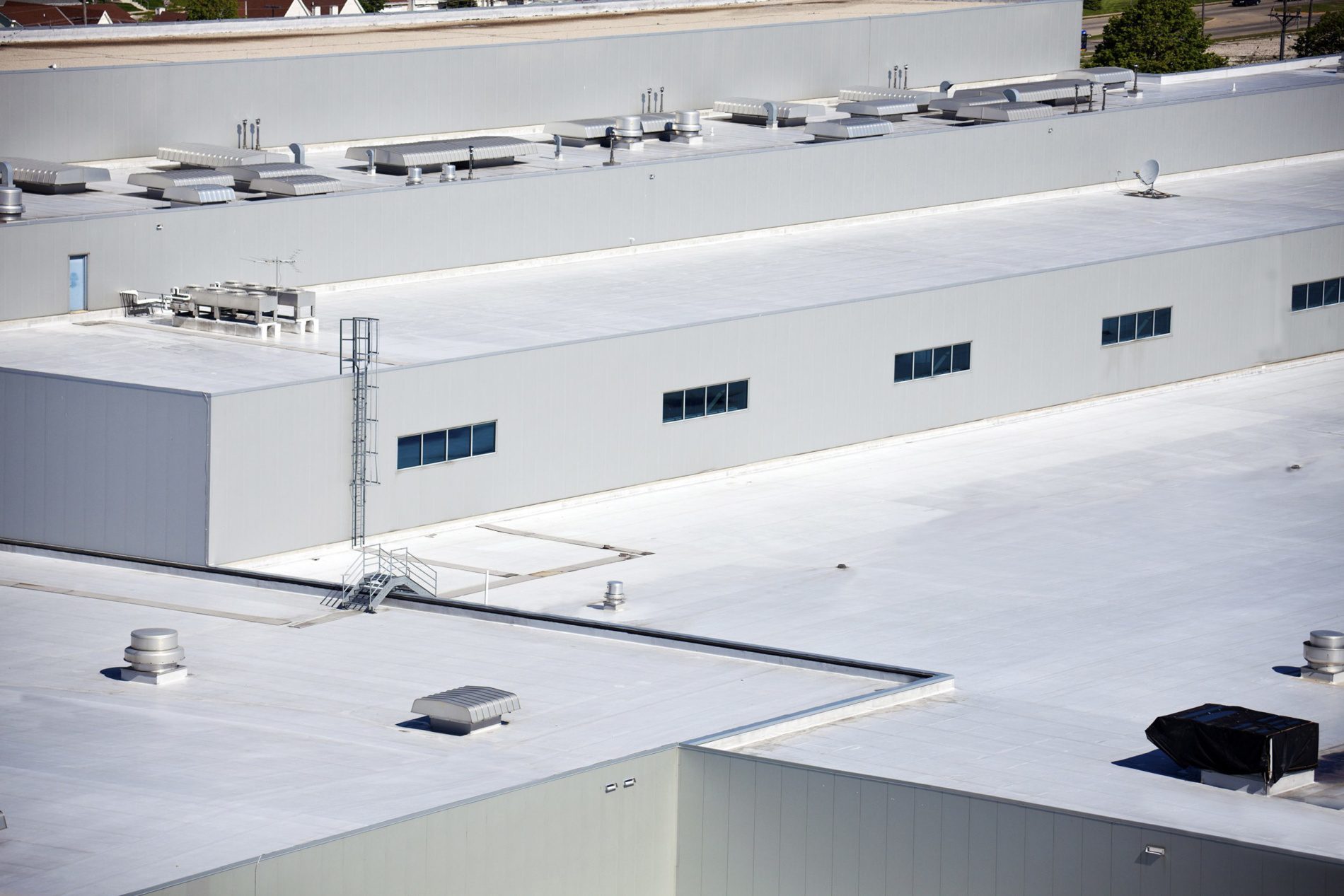
Manufacturing Facility Roofing starts with the condition of the roof in front of us
Commercial roofing for manufacturing plants, production facilities, and industrial buildings.
Steelcase, headquartered in Grand Rapids and operating one of the largest office furniture manufacturing campuses in North America, represents the kind of high-complexity industrial roofing client that defines commercial roofing in West Michigan. With millions of square feet of fabrication, finishing, and distribution space spread across the Grand Rapids metro area, the roofing demands of the local office furniture manufacturing sector require contractors who understand process equipment integration, lacquer and solvent fume management, precision scheduling around production runs, and the specific load requirements of overhead conveyor systems that thread through roofing penetrations at dozens of points.
The roof of an office furniture plant is essentially a utility platform. Powder coating exhaust stacks, paint booth ventilation units, HVAC equipment serving climate-controlled assembly areas, and compressed air system components all compete for rooftop real estate. When a re-roof project is planned, the mechanical inventory must be completed before specifications are written. Every penetration needs to be measured, photographed, and assessed for curb condition, flashing integrity, and compatibility with the proposed new membrane system. In a Grand Rapids winter, a single improperly flashed exhaust curb can admit enough water to shut down a powder coating line.
Solvent and lacquer fume exposure is a specific chemical challenge on Grand Rapids furniture manufacturing roofs. Traditional petroleum-based solvents used in wood finishing operations can attack asphaltic membranes over time, causing softening and adhesion loss around exhaust curb flashings. A contractor specifying a built-up or modified bitumen system for a finishing facility needs to confirm that the cap sheet and flashing compounds are formulated for solvent resistance, or specify a thermoplastic membrane that provides inherent chemical resistance without additional treatment.
Vibration from stamping presses, automated cutting equipment, and metal fabrication machinery is a roofing durability factor in Grand Rapids facilities that produce metal components for furniture frames. The cyclic loading transmitted through the building structure creates micro-movement at fastener locations and membrane seams. Fully adhered systems installed over rigid insulation boards provide the most consistent performance in these conditions. Where mechanically fastened assemblies are specified for cost reasons, fastener pull-out testing should be conducted on the existing roof deck before the layout pattern is finalized.
Skylights are a design priority on Grand Rapids manufacturing floors. The furniture industry places a premium on color accuracy in finishing and quality control operations, and natural daylight provides a truer reference than artificial lighting for evaluating stains, upholstery materials, and painted surfaces. When skylights need replacement, the contractor should work with the facility team to identify whether the existing units meet current building code requirements for fall protection, whether the glazing meets daylighting performance targets, and whether the curb height complies with current OSHA standards for rooftop safety.
Roof drain management on Grand Rapids industrial properties carries both operational and environmental considerations. West Michigan receives significant snow and spring rain, and a furniture plant roof with blocked or undersized drains can accumulate structural loads that exceed design limits quickly. More critically, manufacturing effluent that reaches roof drains can enter the storm system. A proper assessment identifies every drain, confirms its size relative to the tributary area it serves, and ensures that any drain located near chemical storage, paint booths, or solvent use areas is connected to the appropriate waste collection system rather than the storm drain.
Questions We Answer Before Work Starts
How do you decide whether Manufacturing Facility Roofing needs repair or replacement?
We start with roof condition, moisture concerns, drainage, age, access, and recurring leak history. Repair is recommended when it solves the problem cleanly. Replacement is discussed when repeated repairs are only chasing symptoms.
Can the building stay open during manufacturing facility roofing work?
Most commercial roof work can be staged around an active building when access, loading, noise, odors, and end-of-day dry-in are planned before crews arrive.
What do owners receive after an inspection?
Typical documentation includes photos, notes on membrane and metal conditions, drain observations, repair priorities, and a practical next-step recommendation.