

Pharmaceutical & Laboratory Roofing changes access, staging, and risk below the roof
A leak over a cleanroom or a cold vault is not a maintenance ticket, it is a quarantine event. We roof regulated lab buildings to keep it from ever getting that far.
On a warehouse, a roof leak is an inconvenience and a bucket. On a pharmaceutical or laboratory building, the same leak can land over a cleanroom, a GMP production suite, a stability chamber, or a cold-storage vault, and the cost stops being about roofing. It becomes a deviation report, a possible product hold, a regulatory notification, and remediation that dwarfs anything the roof itself was worth. We approach these buildings knowing that the acceptable-leak tolerance is effectively zero, and that the way we plan, document, and detail the work has to reflect that.
Grand Rapids sits at the center of West Michigan's life-sciences cluster, and there is real demand behind these buildings. The Medical Mile along Michigan Street NE anchors the region with the Van Andel Institute, the MSU College of Human Medicine research building, and clinical and translational labs feeding off them. The Monroe North district and the corridor toward the Walker and Comstock Park industrial parks hold contract manufacturing, diagnostics labs, and device companies. These are credentialed, access-controlled buildings, and a roofer who shows up without being pre-cleared simply burns a mobilization day at the gate.
Regulated facilities control who is on site, when, and with what paperwork. Depending on the building that can mean advance contractor qualification, background checks, escorted access, and in buildings with controlled-substance handling, additional security clearance for anyone working near those areas. We start credentialing during preconstruction, usually weeks ahead of mobilization, so the full crew is cleared before day one. Escort rules, restricted zones, and hours are written into the preconstruction plan rather than discovered on the roof.
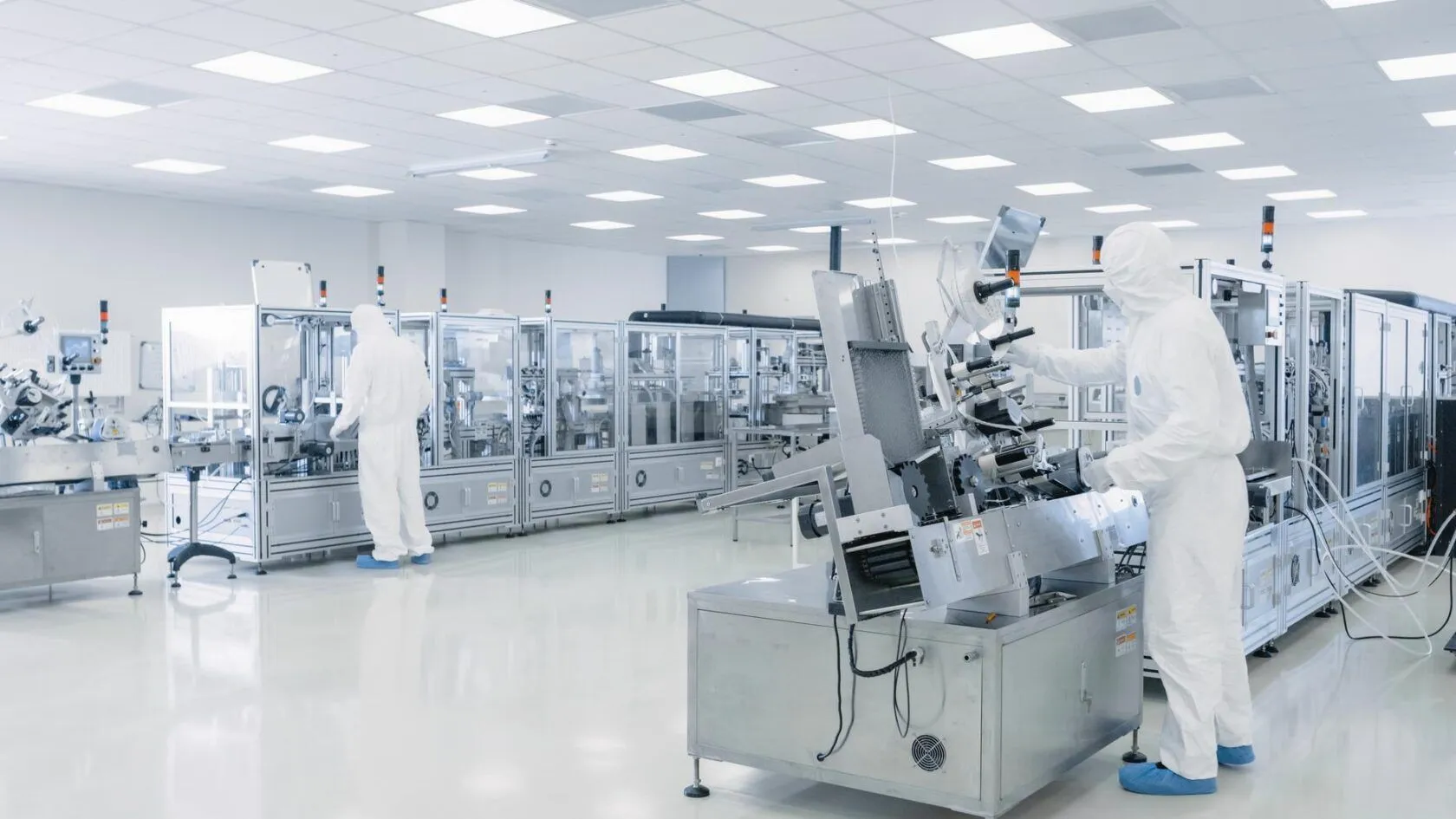
Lab and pharma roofs carry some of the densest mechanical loads in commercial construction. You have HVAC holding ISO-classified cleanroom spaces to tight pressure and particle limits, chemical fume exhaust, biosafety exhaust with HEPA stacks, process cooling, and building-automation conduit, all penetrating the membrane in tight clusters. The part that trips up a general commercial roofer is the pressure relationship below: any work that disturbs the air balance between cleanroom zones, even briefly, has to be coordinated with the facility's MEP team, and we often verify that the differential has recovered after we finish flashing near a critical curb. Every curb and penetration gets flashed and documented as its own item.
Lab exhaust is the quiet membrane-killer. Corrosive solvent or acid vapor leaving a fume stack can condense on the stack and drip back onto the surrounding membrane, etching localized chemical-attack spots that a standard warranty will not cover. Before we spec membrane in the zone around an exhaust stack, we work with the facility MEP team to understand what is actually in that exhaust stream. Where the stream is aggressive we use a chemically resistant membrane, typically a reinforced PVC, and confirm it against the manufacturer's chemical-resistance data for those specific compounds. Standard TPO does not belong downwind of a solvent or acid stack.
The rooms with the lowest leak tolerance are often the coldest. Refrigerated drug vaults, walk-in stability chambers, and cold rooms holding biologics or reagents create a steep temperature difference between a deeply chilled space and the conditioned plant around it, and that difference drives moisture into the roof assembly if the vapor retarder is placed wrong. West Michigan's cold, wet winters and humid summers make the vapor drive reverse across the seasons, so an assembly over a cold vault has to be designed for both directions rather than one. We treat the insulation and vapor control over these rooms as a building-science problem first, because the failure here is hidden condensation that corrodes the deck and soaks insulation without ever showing a drip on the ceiling tile, which is the worst kind of failure to find in a regulated building.
Questions We Answer Before Work Starts
How do you decide whether Pharmaceutical & Laboratory Roofing needs repair or replacement?
We start with roof condition, moisture concerns, drainage, age, access, and recurring leak history. Repair is recommended when it solves the problem cleanly. Replacement is discussed when repeated repairs are only chasing symptoms.
Can the building stay open during pharmaceutical & laboratory roofing work?
Most commercial roof work can be staged around an active building when access, loading, noise, odors, and end-of-day dry-in are planned before crews arrive.
What do owners receive after an inspection?
Typical documentation includes photos, notes on membrane and metal conditions, drain observations, repair priorities, and a practical next-step recommendation.