

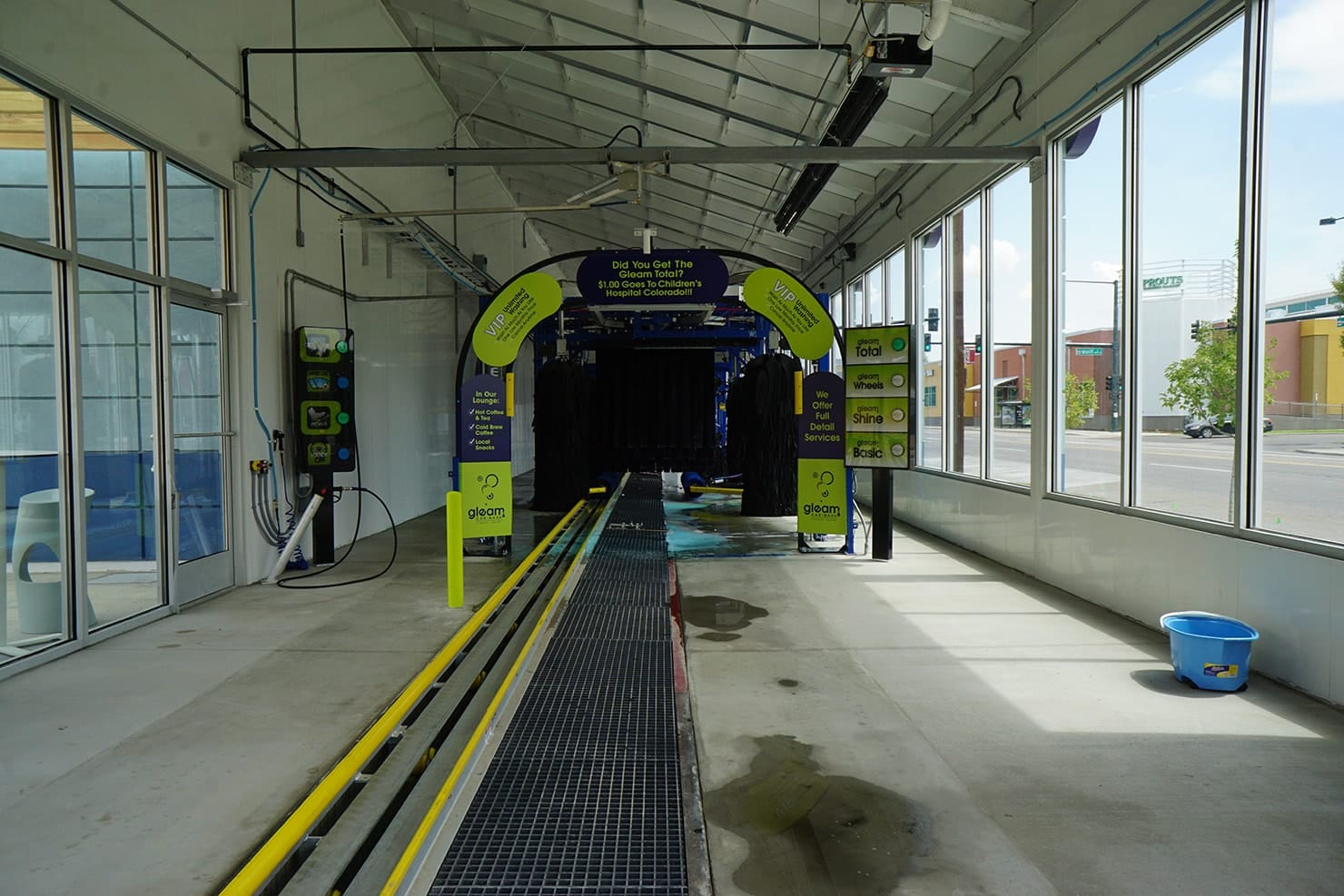
Car Wash Facility Roofing changes access, staging, and risk below the roof
Tunnel humidity, chemical vapor, and canopy transitions wreck ordinary roofs. We build car wash roofs that hold up to all three.
A car wash punishes its roof from the inside out. Most commercial buildings deal with weather coming down onto the membrane; a wash tunnel deals with a warm, saturated, chemically loaded fog rising up against the deck twenty hours a day. Hot water atomizes, detergent and tire-shine and drying agents go airborne, and that vapor finds every fastener head, seam, and curb from underneath. The damage you eventually see as a ceiling stain usually started months earlier as corrosion on the deck and rusted fasteners you could not see from the roof surface. We treat that vapor as the primary design problem on every wash we work on, not an afterthought.
Grand Rapids has a dense and growing wash market because it has the traffic to feed it. The 28th Street SE corridor through Cascade and Kentwood, the Alpine Avenue retail strip up in Walker, Plainfield Avenue heading toward Plainfield Township, and the Division Avenue spine all carry the daily car counts that express tunnels are matched to. New construction has clustered near the Knapp's Corner and Beltline interchanges where rooftop traffic is heaviest, and older in-bay and self-serve sites along Leonard Street and Wealthy Street are now a generation into their original roofs. Whether the building is two years old or thirty, the failure mode is the same: vapor and chemistry attacking from below while Michigan freeze-thaw works the membrane from above.
The roof directly over the active wash equipment takes the worst of it. You have steam, alkaline detergent mist, acidic presoak vapor, and thermal cycling from hot-water blowoff all hitting the same square footage. Single-ply membranes do not all respond the same way to that exposure. The plasticizer chemistry that keeps a membrane flexible is exactly what aggressive detergents and solvents leach out, and once a membrane goes brittle over a tunnel it cracks at the seams and around penetrations fast. Before we recommend anything we ask what chemical program the operator actually runs, because the wax-and-ceramic menu at a high-end express site is a very different exposure than a basic in-bay auto.
For that tunnel zone we lean toward PVC over TPO or EPDM. PVC holds its plasticizers better against the alkaline and solvent exposure typical of commercial wash chemistry, and a fully adhered installation kills the membrane flutter you get from tunnel air pressure and blower wash. Mechanical attachment puts a field of fastener penetrations directly into the worst vapor zone, which is the last place we want more holes. We also detail every exhaust and blower penetration as its own item, because the high-volume fans pulling steam out of the tunnel run constant warm humid air right past the flashing.
An express exterior tunnel with the full chemical menu has the most aggressive vapor load and the densest rooftop equipment. In-bay automatics have lower vapor but frequently have drainage problems, because the roof above the bays was framed flat and now ponds every time it rains. Self-serve bays are the lowest chemical exposure but the most exposed to neglect, since there is rarely anyone watching the roof. We scope each type to what it actually is rather than handing every wash the same proposal. On almost every in-bay and self-serve building we look at, the first real finding is ponding water sitting over the bays, which is a tapered-insulation and drainage fix as much as a membrane one.
The vacuum islands and customer canopies on the exit side are their own headache. They are usually steel or EPDM-clad, they catch vehicle exhaust and tire-dressing overspray, and they live outside in full Michigan sun and snow load. The single most common leak we find on an express site in Grand Rapids is not the main roof at all, it is the transition where a canopy ties into the building wall, or the canopy drain connection that was never flashed to last. Those transitions move differently than the main roof and need to be detailed and maintained on their own.
Questions We Answer Before Work Starts
How do you decide whether Car Wash Facility Roofing needs repair or replacement?
We start with roof condition, moisture concerns, drainage, age, access, and recurring leak history. Repair is recommended when it solves the problem cleanly. Replacement is discussed when repeated repairs are only chasing symptoms.
Can the building stay open during car wash facility roofing work?
Most commercial roof work can be staged around an active building when access, loading, noise, odors, and end-of-day dry-in are planned before crews arrive.
What do owners receive after an inspection?
Typical documentation includes photos, notes on membrane and metal conditions, drain observations, repair priorities, and a practical next-step recommendation.